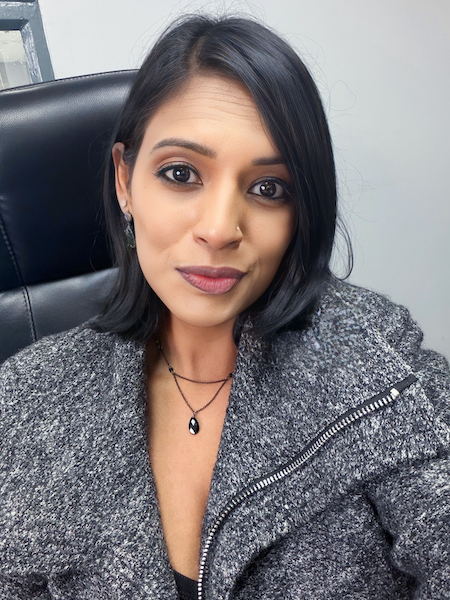
For Women’s Month, Change 1 Woman (C1W) interviewed Riasha Naidu, Managing Director of Unistar Inks, about her experience as a woman in the printing, ink and manufacturing industries.
Naidu discussed the challenges of working in traditionally male dominated environments, the influence of her late father and mentor, and what companies and industry leaders can do to create meaningful opportunities for women. She also shared advice for young women entering technical and leadership roles, while highlighting the importance of men and women working together to build more inclusive workplaces.
What challenges have you faced as a woman in your industry, and how did you overcome them?
The printing, ink and manufacturing industries are still largely male dominated, particularly when you move into technical, operational and senior leadership roles. One of the biggest challenges I have faced is having to prove credibility before being given it.
There have been times when I have been the decision maker in the room, yet questions or responses have instinctively been directed towards a male colleague. Those experiences can either make you question your place in the room, or they can push you to become so knowledgeable that your capability becomes impossible to overlook. I chose the latter.
I learnt very early that credibility is built through competence. I have an MBA and can talk business strategy for hours, but I can also walk onto a factory floor and guide you through pigment dispersion, agglomeration, resin systems and the variables that affect ink performance on press.
For me, it was important not to allow myself to be confined to the commercial side of the business simply because I was a woman. I deliberately immersed myself in the science, manufacturing and technical aspects of our industry. I wanted to understand not just what we manufacture, but why formulations behave the way they do, what happens when something goes wrong and how we solve it.
That depth of knowledge gave me confidence in rooms where I may initially have been underestimated. It also taught me something important: you cannot always control people’s initial perception of you, but you can control the substance you bring into the room.
Eventually, you stop worrying about proving that you belong there. Your knowledge, capability and results speak for you.
Who has been the biggest influence or mentor in your career?
My late father, Mr Dasson Pillay, without question.
His way of mentoring me was never about making the path easier. It was about preparing me to walk it on my own. He pushed me into situations I did not always feel ready for. He allowed me to take the lead, make decisions, speak for myself and face uncomfortable situations rather than stepping in to protect me from them.
Sometimes I wanted him to give me the answer. Instead, he gave me the responsibility to find it. He allowed me to make mistakes, but he also expected me to learn from them. He challenged my thinking, questioned my decisions and pushed me beyond what I thought I was capable of.
At the time, I probably did not always appreciate how intentional that was. He believed in my capability before I fully understood it myself. He taught me to trust my judgement, find my voice and become comfortable being uncomfortable.
Most importantly, he never made me feel that being his daughter meant I should stand behind him. He created space for me to lead alongside him.
Looking back now, I realise he was not simply teaching me how to run a business. He was preparing me to lead one without him. He gave me the space, confidence and courage to eventually stand on my own.
What advice would you give to young women who want to follow a similar career path?
Do not wait until you feel completely ready. Apply for the position. Walk into the technical meeting. Ask the question. Learn how the machine works. Understand the numbers. Volunteer for the project that scares you. Put your hand up before you have convinced yourself that somebody else is more qualified to do it.
And most importantly, build substance behind your confidence.
There is enormous power in being the person in the room who has done the homework. You do not need to know everything, and you should never pretend that you do, but you should remain relentlessly curious.
Learn beyond your job title. If you work in finance, understand operations. If you work in sales, understand production. If you work in management, spend time with the people doing the work. The broader your understanding of a business becomes, the more valuable your perspective becomes.
I would also tell young women not to believe that leadership requires them to become harder, colder or more like the men around them. Empathy, emotional intelligence, collaboration and intuition are not weaknesses. When combined with competence, courage and decisiveness, they can be incredibly powerful leadership qualities.
You do not need to change who you are to earn your seat at the table. And if there is not a seat for you yet, do not be afraid to bring your own chair.
What can companies and industry leaders do to better support women in the workplace?
We need to move beyond celebrating women once a year and start examining the structures that determine who actually progresses.
It is easy to talk about empowerment. The more difficult questions are: Who is being mentored? Who is being exposed to technical roles? Who is invited into strategic conversations? Who gets the high visibility projects? Who gets succession opportunities? And who is being actively prepared for leadership rather than simply being told that leadership opportunities exist?
In industries such as manufacturing and printing, I would particularly like to see more women encouraged into technical, engineering, production and operational roles.
Representation at senior level matters, but the pipeline matters just as much. We cannot ask why there are not enough women around the boardroom table if we have not created opportunities for women on the factory floor, in laboratories, in engineering, in operations and in commercial roles along the way.
Mentorship is important, but sponsorship is equally important. Women need leaders who will not only give them advice privately, but who are prepared to put their names forward when opportunities arise.
Companies need to create environments where women are given the exposure, experience and responsibility required to eventually occupy senior positions.
That is how representation becomes sustainable rather than symbolic.
How can both men and women work together to create more inclusive workplaces?
Inclusion cannot be a women’s initiative. If we want meaningful change, men must be part of the conversation too.
Sometimes inclusion begins with becoming conscious of behaviours we have normalised: who gets interrupted in meetings, whose idea gets acknowledged, who is assumed to be the decision maker, who gets invited into the room and who is given the opportunity to lead.
These may seem like small things, but over the course of a career they shape confidence, visibility and opportunity. Men can be incredibly powerful allies by recognising those moments and challenging them, particularly when they are already in positions of influence.
At the same time, women have a responsibility to support other women. We should celebrate each other’s success, share opportunities, mentor younger women and create space for one another.
There is enough room for more than one woman at the table. Ultimately, inclusion should not be framed as women versus men. We need both perspectives. Different experiences and ways of thinking make organisations stronger.
The goal should be a workplace where talent, ideas, work ethic and capability determine how far someone can go.
What does empowering women mean to you?
For me, empowering women is not about giving women power. Women already have power. It is about ensuring that power is recognised, supported and fully utilised by removing the barriers that too often limit how far it can go.
It means creating genuine access to opportunity, education, mentorship, networks and leadership pathways, and building environments where women feel confident to step forward into spaces where they may not have historically been represented.
But empowerment is not a one way process. It also comes with responsibility. Every time a woman breaks through a barrier, she has the chance to make that path easier for the next woman behind her. That is how real, lasting change happens.
I do not want success to be defined only by the seat I have earned at the table. I want it to be defined by how many more seats we create for others to join us.
Africa Print are proud media partners of the Women in Print series hosted by Printing SA this month.
C1W Initiative
Change 1 Woman (C1W) aims to empower women in the branding, print and signage industries. As part of this initiative, Africa Print would like to spotlight women-focused content like this piece. If you have any trend/business articles related to the signage, branding and printing industries, please email content to: info@c1w.co.za. Follow C1W on Facebook, LinkedIn and Instagram for more updates.
UNISTAR INKS
unistarinks.com