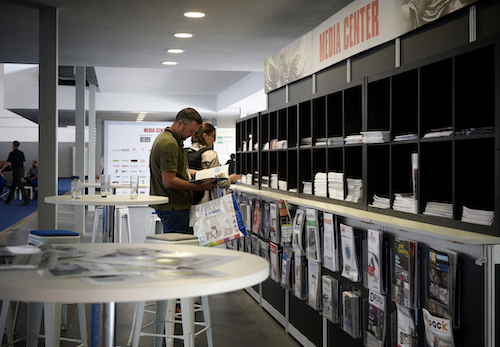
Labelexpo becomes LOUPE (Labels and Outer Packaging Embellishment) in 2026, a name that casts a wider lens across labels, flexible packaging, and folding carton industries, while remaining the global home for labels. FINAT has been proud to stand alongside it as a long-term association partner. Jules Lejeune, FINAT Managing Director, outlines a range of trends in the labelling space.
Over the last 20 years, labels have evolved from a mainly print-and-convert self-adhesive application into an increasingly integral packaging and information layer, intensifying their critical, high-value role in branding, protection, compliance and, increasingly, traceability. The last decade accelerated the shift: shorter runs, faster changeovers and rising SKU complexity put a premium on flexibility, speed and repeatability.
Technology also moved from incremental press improvements to workflow-led competitiveness: automation, inspection, colour control and data discipline. But the biggest change is structural: convergence. Self-adhesive labels remain the anchor, yet the industry shift towards the broader application of narrow-web technologies stands at the core of where we are going. Sleeves, IML and selected flexible packaging increasingly share the same technology base and skillsets: printing, finishing, substrates and digital workflow. Converters are exploring where narrow-web capabilities translate into new value, and where embellishment is becoming a stronger part of brand differentiation.
Where We Are Now: From Recovery To Recalibration
From a European market perspective, the past cycle has been challenging. 2025 marked a shift from recovery into recalibration, with a recorded growth in the self-adhesive label materials consumption at 2%, in line with GDP. The market is more stable entering 2026, but growth is modest and uneven, and uncertainty remains the baseline.
Two signals stand out. First, demand is increasingly mixed by application: variable information printing linked to logistics and distribution has been structurally stronger than primary product labelling during periods of cautious consumer spending. Second, the mix of materials and functionality continues to evolve, driven by sustainability requirements, performance demands and the growing role of traceability. Proof is becoming the new currency: solutions must be compatible with recycling systems and compliance expectations.
What Comes Next: High-Tech, Circular And Compliant
Looking ahead, we see three trends shaping the next few years.
Sustainability moves from ambition to execution. In Europe, regulations like PPWR and customer requirements are pushing the market from intent to implementation. Companies increasingly need evidence-based design-for-recycling compatibility, credible data, and scalable end-of-life solutions. This is not only a European story: global brand owners and supply chains carry these requirements across regions.
Circularity becomes a system challenge. It will scale when collection, sorting, recycling capacity and end markets become economically viable. That is why FINAT (and the CELAB-Europe consortium that it hosts) works, where needed, with key players in the wider packaging and recycling ecosystem: converters and their end-customers need solutions that are technically sound, operable at scale, and compliant as requirements evolve. Collaboration is not ‘nice to have’; it is strategic infrastructure.
Digitalisation, and increasingly AI, become the productivity lever. Short runs, SKU proliferation and tighter turnaround expectations make automation, workflow discipline and data-driven process control more central to competitiveness. Traceability is also gaining momentum as a practical tool for supply-chain efficiency, compliance and circular systems.
LOUPE
www.loupe-global.com