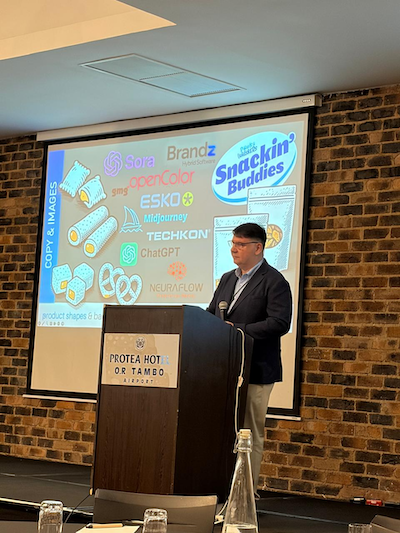
At the Flexo Frontier 2026 seminar hosted by Flexographic Technical Association of South Africa (FTASA) with Printing SA in February, Marek Skrzynski, Vice President of Technology & Innovation at CSW Inc., explored how corrugated packaging and flexographic printing have evolved from simple shipping tools into advanced, brand-driven solutions shaped by e-commerce, consumer expectations, and the need to balance high-quality design with efficiency and sustainability.
The evolution of flexographic printing in corrugated packaging reflects a broader transformation of the corrugated box itself. From a purely functional shipping container into a sophisticated medium for branding, efficiency, and consumer engagement. What was once a utilitarian object has become a central component of modern commerce, shaped by advances in printing technology, supply chain demands, and shifting consumer expectations.
Corrugated packaging has long held a unique dual identity. It is both ubiquitous and overlooked, yet deeply embedded in global trade and everyday life. Historically, corrugated boxes served primarily as secondary packaging, designed for protection, stacking strength, and transport efficiency. Their visual appearance was largely irrelevant, as they were rarely seen by end consumers. This functional focus aligned with early Flexo printing, which prioritised durability and cost-effectiveness over high graphic quality.
However, the rise of e-commerce fundamentally altered this dynamic. Corrugated boxes transitioned from back-end logistics tools to front-line brand touchpoints. As online retail eliminated traditional store shelves, the shipping box often became the first physical interaction between a brand and its customer. This shift elevated expectations for visual quality, consistency, design and placed new demands on flexographic printing.
Over the last two decades, Flexo printing, already the dominant technology in packaging, adapted to meet these requirements. Representing the largest share of the global packaging print market, Flexo has evolved from basic direct printing into a highly advanced process capable of delivering high-resolution graphics, precise colour control, and large-format consistency. Modern systems incorporate servo-driven presses, vacuum sheet handling, and multi-colour capabilities, enabling production speeds of thousands of sheets per hour while maintaining improved print fidelity.
Social media driven trends such as ‘unboxing’ have elevated expectations for visual presentation. Redefining packaging as both an experiential and shareable moment. The act of opening a box is now closely tied to brand storytelling, anticipation, and perceived value. Shifting corrugated packaging beyond its traditional structural role into a visual communication platform. Double-sided printing further extends this shift by turning the interior of the box into an additional communication surface. Often making what’s inside as important as what appears on the outside. In response, flexographic printing has advanced significantly. Narrowing the quality gap with offset and digital processes while achieving sharper images, smoother gradients, and more consistent registration on corrugated substrates.
The structural versatility of corrugated packaging has expanded significantly, with retail-ready packaging (RRP) clearly illustrating this evolution. Well designed corrugated solutions now transition seamlessly from shipping to shelf display with little or no modification. Engineered for immediate placement, often without any tools, these formats significantly reduce restocking time and in-store labour requirements. By eliminating intermediate handling steps, they streamline retail operations while ensuring consistent product presentation. This dual function places increased demands on both structural and graphic design. As packaging must deliver clear, effective branding in a retail environment while remaining robust, efficient, and cost-effective for shipping at scale.
Parallel to these developments is the rapid growth of subscription based commerce and product ‘kitting.’ These models rely heavily on corrugated packaging to deliver curated experiences directly to consumers. With millions of weekly deliveries in categories such as meal kits and personal care, the need for consistent, high-quality printed packaging has intensified. Flexo’s scalability and adaptability have made it the primary solution for meeting these high-volume demands.
Despite these advancements, the corrugated industry faces persistent challenges related to efficiency and sustainability. One of the most significant issues is dimensional inefficiency, where boxes are larger than necessary. Leading to increased shipping costs and wasted space. Innovations such as ‘Box-on-Demand’ systems and ‘Fit-to-Product’ aim to address this by producing custom sized boxes in real time. These systems improve shipping density, reduce material waste, and introduce new requirements for flexible, responsive printing processes.
Sustainability is also a big driver of change. Flexo printing, well suited to direct printing on corrugated board with increasing recycled content, aligns with growing consumer and regulatory pressure for recyclable packaging. However, higher recycled fiber content introduces structural challenges. Making consistent print quality harder to achieve. At the same time, ‘down-gauging,’ or reducing liner weight, lowers material use and transport costs. However, it further complicates print performance. Balancing sustainability with performance remains a complex act.
The sophistication of the flexographic prepress now rivals, and in some cases exceeds, that of other printing methods. It also however reflects the growing complexity of corrugated packaging requirements. It must continue to evolve to manage the inherent trade-offs between structural integrity and visual quality.
Ultimately, the evolution of Flexo-printed corrugated boxes is a story of convergence, where logistics, branding, sustainability, and technology intersect. What began as a simple protective solution has transformed into a multi-functional platform capable of shipping, displaying, and marketing products simultaneously. Flexo printing, once valued primarily for its efficiency, now plays a central role in enabling this integrated performance.
As global packaging markets continue to grow and e-commerce expands, the importance of corrugated packaging will only increase. The future of Flexo-printed corrugated boxes lies in continuous innovation. Advancing the print quality on increasingly demanding substrates, expanding automation and mass customisation, and aligning sustainability goals with performance requirements. As printing extends to both exterior and interior surfaces, the corrugated box evolves beyond a simple container into a fully integrated, inside–outside interface connecting product, brand, and consumer.
CSW, INC.
https://cswgraphics.com/