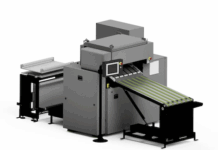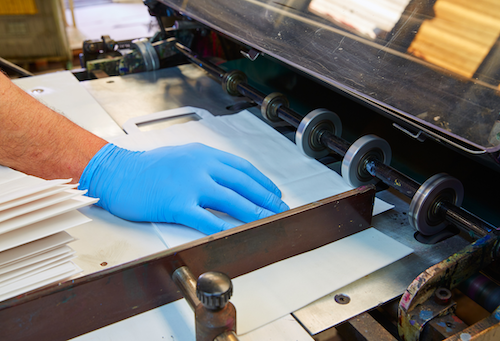
Focus Label Machinery outlines the pros and cons of three of the most popular and useful types of flexo printing ink. There are several factors to think about before getting started, such as the nature of the final product, the speed needed for printing, and chemical issues, with the most important consideration being the substrate used.
To get the best results from a printing press, users will always need to choose an ink with full compatibility with the chosen substrate.
Water-Based Ink
Water-based ink is one of the most cost-effective options; however, the inks may have problems drying quickly without assistance. These inks are best used on absorbent substrates, where they will dry well without the need for complex curing machinery.
Sometimes, water-based ink has a reputation for producing a poor-quality finish but this tends to be a result not of the ink itself, but of other factors. These include using water-based ink on an unsuitable substrate, where its high surface tension causes poor absorption. In some cases a pre-treatment such as Corona is recommended for synthetic substrates, which will improve print quality.
A good drying system is essential when using water based inks combing both IR lamp technology and forced air systems. Old printing machinery will be ill equipped to deal with water-based ink.
Solvent-Based Ink
Solvent-based inks are made up of alcohols and acetates, and have a much lower surface tension than water-based ink. They dry well, and offers a fast printing solution. Solvent-based inks can be dried in conventional curing ovens, and are quick-drying.
Solvent-based inks work well on non-absorbent substrates, including foils, metallic wrappings and plastic bags. Both water-based and solvent-based inks are classified as volatile inks. This means that they contain a liquid component that evaporates, leaving its image behind to mark the substrate. This poses a health and environmental risk with many solvent inks, as the evaporation process releases volatile organic compounds (VOCs) into the atmosphere.
When using solvent based inks, a good drying system that combines both IR lamp technology and forced air systems is essential. Old printing machinery will be ill equipped to deal with solvent inks.
UV-Ultraviolet And Electron Beam Inks
Unlike volatile inks, these inks are designated as being energy curable. This means that they dry through intermolecular bonding, leaving the ink solidified on the surface of the substrate – without releasing VOCs.
These inks will only dry when exposed to UV or LED UV light or electron beams in a specialised curing oven. This increases the infrastructure costs of working with these inks, as one will need to invest in equipment which contains the appropriate drying system. But they are still the most sustainable option for printing non-absorbent surfaces. UV inks have a high viscosity and are often used in food packaging. They achieve a crisp, extremely high-quality finish, delivering an excellent ROI even if their cost per ml is higher than volatile inks.
UV and LED UV technology is widely used on narrow web presses throughout the industry, with an economic solution being easily retrofittable to existing presses.
Electron beam technology is relatively new, usually very large and expensive to install on smaller presses. It has found its way onto some wide web press applications and is gaining some interest from the food sectors for the ink’s safety for direct packaging.
FOCUS LABEL MACHINERY
https://www.focuslabel.com