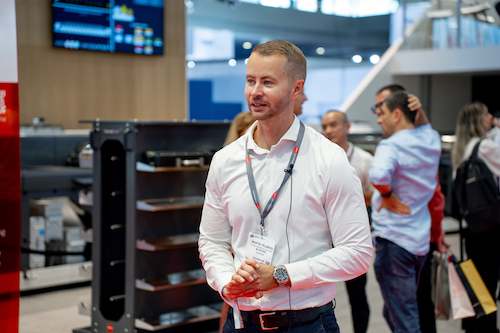
Martin Teilberg, Global Marketing Manager at Nilpeter, discussed flexo trends, the importance of data, opportunities in South Africa and more.
1. What are the top 2026 flexo industry trends?
The biggest trend in 2026 is that flexo continues to strengthen its position as the most scalable and commercially robust technology for mainstream label production. We see converters investing in higher automation, wider use of Extended Colour Gamut (ECG), stronger workflow integration, and significantly improved productivity.
At the same time, we see more converters working with multiple technologies. But it is important to be clear: we do not see a future where hybrid press configurations, combining flexo and digital in one machine, will dominate the market. Instead, we see converters building production environments where different technologies are combined in a way that makes commercial sense for their business. In that setup, flexo remains the backbone due to its speed, efficiency, and cost advantages.
We also see a much stronger focus on live production data. Converters want real-time visibility into performance, waste, uptime, and repeatability. That data is becoming essential for making faster and better decisions. At Nilpeter, this is a key focus area, because the real value lies in turning data into actionable improvements on the shop floor.
2. What are the challenges and opportunities in the South African flexo market?
South Africa is one of the most established packaging and label markets on the continent, and that creates real opportunity. There is strong demand for quality, brand differentiation, and production reliability, especially in segments such as wine, beer, spirits, and premium consumer goods. At the same time, customers are under pressure to deliver more flexibility, shorter runs, and faster turnaround.
The challenge is that converters need to balance investment discipline with the need to modernise. Productivity, automation, skills, and consistency are becoming more important, because competition is increasing and customers expect more. The opportunity is clear: converters that invest in efficient, highly automated flexo platforms can position themselves very strongly in a market that is evolving and professionalising quickly.
3. What are some persistent myths about flexo printing?
One myth is that flexo only makes sense for long runs. That is no longer true either. With today’s automation, reduced setup times, and improved repeatability, flexo is far more competitive on shorter and more complex jobs than many still assume.
And finally, there is still a myth that digital will automatically replace flexo. We do not see it that way. The market is moving towards hybrid thinking, in which converters mix technologies where they add value to their business, not replacement. Flexo remains the industrial production engine because of speed, scale, and economics.
4. Will we see an increase in AI-driven workflow optimisation this year and how will this streamline production and benefit printing businesses?
In 2026, AI is becoming more practical and less theoretical in print production. We see it being applied in planning, estimation, prepress optimisation, quality control, and predictive process improvements rather than replacing operators on press.
The real benefit is better decision-making and less waste. AI can help identify inefficiencies faster, optimise job planning, improve repeatability, and reduce the amount of manual intervention in the workflow. For converters, that means shorter lead times, fewer errors, better use of materials, and more stable production economics.
But it is important to stay grounded. AI will not fix a poor workflow on its own. The real value comes when AI is built on strong process control, reliable machine data, and an integrated production environment. That is where we see the industry heading.
5. With the growing emphasis on sustainability, where does the flexo industry fit in with this, and in which areas are we seeing the greatest sustainable impact?
Flexo is very well positioned in the sustainability agenda, especially when it is automated and configured for efficient production. The biggest impact comes from reducing waste, lowering energy consumption, shortening setup times, and improving right-first-time performance. Sustainability in print is not only about materials, it is equally about production efficiency.
We are also seeing sustainable impact through smarter colour strategies such as ECG, better workflow control, and technologies that reduce material loss and unnecessary stoppages. In our view, the strongest sustainability gains come when converters combine machine efficiency, data visibility, and process standardisation. That is where sustainability becomes measurable.
6. Closing thoughts?
It is a very exciting time to be working in flexo. The pace of development is high, and we see wider machines, higher levels of automation, and rapid progress within data utilisation and AI. This is fundamentally changing how converters approach production and decision-making.
At the same time, we are operating in a world that is more unpredictable than it has been for a long time. Political uncertainty, supply chain challenges, and global instability all put pressure on our industry.
That combination makes it both challenging and exciting. It raises the bar for all of us, as suppliers and as converters. The ones who succeed will be those who can adapt quickly, make the right investments, and build production environments that are efficient, flexible, and resilient.
CSM – NILPETER AGENT
https://csm-sa.co.za