In an era defined by digital saturation, a quiet but significant countermovement is reshaping the marketing and communications landscape: the resurgence of print. Stuart Daniels, Sales Manager for Production Systems at Altron Document Solutions, discusses why print is not only surviving in the digital age, it is evolving, gaining strategic relevance, and asserting itself in ways that digital media simply cannot replicate.
Technology As The Catalyst For Change
The most transformative development in contemporary print is not a single technology, it is the democratisation of capability. Digital printing and finishing have advanced to a point where print service providers and brand owners can now produce precisely what they need, exactly when they need it, without the financial and logistical burden of holding large volumes of pre-printed shelf stock.
This has been a paradigm shift for the industry. Variable data printing, high-definition inkjet, and digital embellishment technologies have collapsed the traditional barrier between short-run viability and quality output. Where offset lithography once demanded high minimum quantities to justify setup costs, digital production now makes runs of one commercially feasible, opening the door to highly personalised, on-demand applications.
‘Because of the technology that allows them to do so,’ noted Daniels, ‘we see a major shift towards more short-run, specialised applications such as packaging, label printing, and more bespoke-work.’ This isn’t incremental change, it is a structural reorganisation of what print can do and who it serves.
‘Digital printing and finishing have evolved to a point where producers have the freedom to print what they need, when they need it, without the expense of a large stock of media or finished goods.’
Print As Psychology: The Neuroscience Of Touch
Perhaps the most under appreciated dimension of print’s resurgence is neurological. A growing body of research in consumer psychology and neuromarketing confirms what intuition has long suggested: physical, tactile media engages the brain differently, and more deeply, than its digital counterpart.
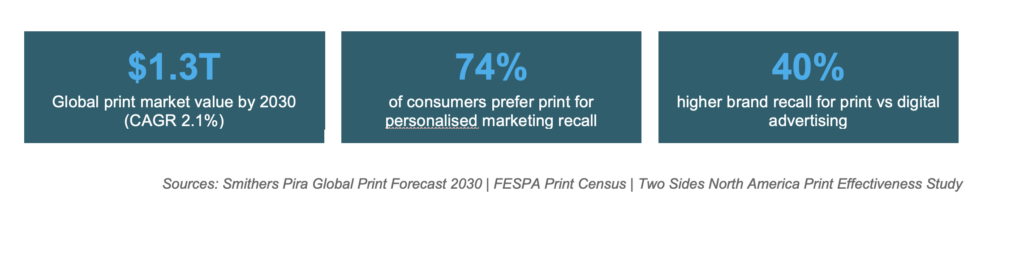
A landmark study by Canada Post and True Impact Marketing found that direct mail requires 21% less cognitive effort to process than digital media, yet produces 70% higher brand recall. Separate research by Temple University’s Centre for Neural Decision Making demonstrated that physical advertising activates the brain’s value and desire centres more intensely than digital ads, translating directly into purchase intent.
Daniels said, ‘Print allows for a more traditional and visceral response to brand messages, where touch, feel, even scent and taste can be leveraged to illicit a response from customers or consumers.’
This is not nostalgia, it is a strategic response to the cognitive fatigue induced by perpetual digital exposure. As screens compete relentlessly for attention, a well-crafted printed piece cuts through precisely because it operates on a different sensory register entirely.
Comparing print’s cyclical relevance to fashion trends is apt. Like bell-bottoms returning to the runway in a modern silhouette, print has re-entered the marketing mix not as a replica of its former self, but as something evolved, purposeful, and complementary to the digital ecosystem around it.
‘Print can be the link between the product and the brain. It has the possibility to trigger something within the brain driving the desire to purchase, or at the very least to stop and look,’ said Daniels.
High-Growth Application Areas
Within the broader print market, several application verticals are experiencing particularly robust demand, each driven by a convergence of consumer expectations, brand strategy, and technological enablement.
Packaging
The global packaging print market is projected to reach $441 billion by 2030 (Smithers), with digital packaging printing among the fastest-growing segments at a CAGR of over 8%. Daniels said, ‘Just as people were said to buy the sizzle and not the sausage, people are influenced by packaging as much as the product. From cosmetics to premium electronics, the packaging speak volumes before the product is even handled.’
This insight is validated at scale. Nielsen research confirms that 64% of consumers try a new product based on packaging design alone. Luxury and FMCG brands are responding with embellished, digitally printed packaging that incorporates foiling, tactile varnishes, and variable imagery to create shelf presence that commands attention.
Personalisation And Targeted Direct Mail
The second major growth driver is hyper-personalised print. The shift from mass-market print runs to individually tailored communications has been enabled by variable data printing (VDP), which allows every piece in a run to carry unique text, imagery, and offers, all at production speed. According to the Data & Marketing Association, personalised direct mail achieves response rates of 4.4% compared to email’s 0.12%, a performance gap that is widening as email inboxes become increasingly congested.
‘Marketing material need no longer be generic. Through personalisation it can speak directly to people about the product, the vertical segment or the value and experience to be expected by the consumer,’ Daniels observed. For South African financial services, retail, and insurance sectors, all heavy users of direct communication, this capability represents a significant and underutilised competitive lever.
Economic Cycles And The Digital Print Advantage
The relationship between macroeconomic conditions and print volume is well-documented. During periods of economic contraction, characterised by inflationary pressure, energy cost volatility, geopolitical uncertainty, and constrained marketing budgets, the industry does not simply contract uniformly. Instead, volume migrates.
Offset lithography, with its dependence on high minimum quantities and longer production lead times, is most exposed during downturns. Digital print, by contrast, is structurally advantaged: its economics are volume-agnostic, its turnaround times are shorter, and its on-demand model eliminates the risk of obsolete stock.
‘We see an increase in digital print volume in many environment that can be attributed to digital printers being more adept at shorter-run, on-demand printing,’ Daniels explained. ‘When the economy is in tension, we see companies cutting back on marketing or attempting to do more with less, and marketing and litho print go hand-in-hand.’
For South African print businesses navigating the current environment of elevated input costs, load-shedding, and subdued consumer demand, this dynamic reinforces the strategic imperative of digital print capability as a resilience buffer, not merely a growth option.
Automation, AI And the Future of Print Production
Looking ahead, Daniels identifies workflow automation as the defining competitive differentiator for print businesses over the next decade, not in the finished product itself, but across the pre-press and post-press value chain.
‘I think in the future we are going to see more focus around workflow automation, not solely on the printing or imaging elements of applications, but more and more on the pre-press and post-press processes, where we will see a focus on streamlining workflows to make print more efficient and more cost-effective.’
Globally, this trajectory is already advanced. During a recent visit to one of London’s largest commercial print operations, Daniels observed a production floor managed by robotics and overseen by a production manager with an IT background, not a traditional print background. This signals a fundamental skills and operational transformation: print is becoming a technology business.
The implications for the South African market are significant, albeit on a delayed timeline. While the cost of labour in South Africa currently moderates the business case for full robotic automation, the adoption of AI-driven workflow management, automated job scheduling, preflight and colour management, and digital finishing integration is already commercially viable and increasingly necessary to remain competitive.
Print businesses that invest in workflow intelligence now will be materially better positioned as labour cost dynamics inevitably shift, and as customer expectations for turnaround speed and personalisation intensity continue to escalate.
The Future Belongs To The Bold And The Embellished
The future of print, Daniels argued, is inseparable from the science of attention. In a media environment where the average consumer is exposed to between 6,000 and 10,000 brand messages per day (Forbes), the brands that will win are those whose printed communications trigger a neurological response that digital cannot manufacture.
Embellishment (foiling, spot UV, soft-touch lamination, raised print, and textured finishes) is the physical vocabulary of that response. It transforms a printed piece from a passive carrier of information into an active sensory experience.
‘The print output is the link between the finished product and the brain,’ Daniels asserted. ‘It must trigger something in the brain to purchase that product, or to capture interest and for you to stop and look at the information on the printed product.’
As psychology is increasingly applied to the design and production of print, informed by neuromarketing, consumer behaviour research, and data analytics, the discipline will continue to evolve from a craft into a precision instrument of commercial influence.
For South African businesses, print service providers, and brand custodians, the message from Daniels is unambiguous: print is not in retreat. It is in reinvention. And those who understand its psychological power, invest in its technological evolution, and harness its unique ability to create lasting impressions will find in it a formidable and enduring competitive advantage.
ALTRON DOCUMENT SOLUTIONS
+27 11 928 9111
hotline.marketing@bdsol.co.za
www.altron.com
https://www.bdsol.co.za