Altron Document Solutions’ Head of Production Systems, Keith Knott, and Epson’s Regional Sales Director for Africa, Gareth Jay, unpack how digital printing is disrupting traditional production models, expanding creative possibilities and putting sustainability under greater scrutiny.
For decades, commercial label printing has operated on the simple principle that bigger runs and bulk purchases made better financial sense. If, however, a customer wanted only a few hundred labels, or a personalised packaging campaign, a limited-edition product launch or a premium finish on an unconventional substrate, the economics and technical constraints of traditional production often made the job difficult to justify. Over the past few years industrial corporate printing solutions are making it increasingly viable for businesses to respond to these requirements without relying on traditional high-volume production models.
With brands launching products more frequently, testing new concepts before committing to national rollouts and creating limited-edition packaging for specific audiences, demand for a more adaptable approach to labelling is higher than ever. This is not to mention smaller producers, from craft beverage makers to boutique cosmetics businesses, that increasingly expect access to the same quality of packaging as larger competitors, exposing the limits of traditional production models.
‘Previously, if you wanted labels, you would have needed 100,000 to make it commercially viable. Now you can do 500,’ said Altron Document Solutions, Head of Production Systems, Keith Knott. The ability to produce commercially viable short runs is changing who gets access to professional label printing. Printers can accept work they would previously have declined, while emerging brands no longer need to tie up capital in large inventories of labels that may become obsolete after a packaging refresh or product update.
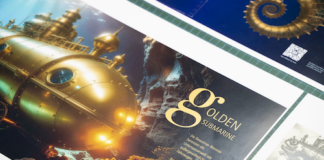
Label printing technology is increasingly shaping creative possibilities as packaging becomes a stronger brand differentiator. ‘White graphics on dark substrates are a good example,’ said Knott. Printing crisp, opaque white text or graphics onto a dark label stock has traditionally been a complex process, with designers often having to work around the limitations of conventional printing.
‘Digital label production allows white to be printed as an ink layer, opening up new creative possibilities on dark and coloured substrates without compromising print quality,’ he added.
The same applies to label materials. Adhesive-backed labels used across the food and beverage industry can be difficult to produce using traditional heat-based printing processes because excessive heat can affect the adhesive. Digital production allows printers to work with a much wider range of label materials, giving brands and designers more choice without compromising print quality.
Personalisation is another area where digital production is changing what’s commercially possible, allowing brands to produce personalised, regional and limited-edition labels in smaller batches, making targeted campaigns far more accessible than they once were.
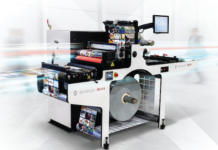
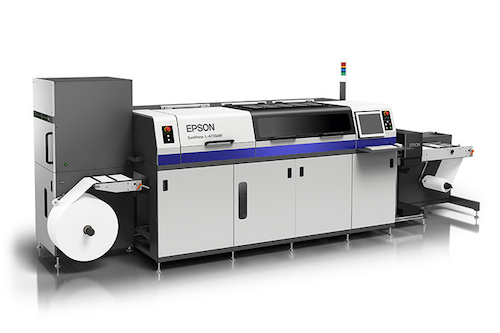
Label printing technology is increasingly shaping creative possibilities as packaging becomes a stronger brand differentiator. Solutions such as Epson’s SurePress L-4733AW digital label press are helping commercial and industrial printers respond to these changing requirements, particularly where shorter runs, variable production and specialised finishes are needed. ‘White graphics on dark substrates are a good example,’ said Knott. Printing crisp, opaque white text or graphics onto a dark label stock has traditionally been a complex process with designers often having to work around the limitations of conventional printing.
Where brands and businesses are in search of printing solutions that meet the sustainability targets, Knott says more consideration needs to be given to the materials used in packaging labels and how their level of recyclability.
‘There’s often an assumption that printing directly onto a bottle or container is the greener option because it eliminates the label altogether,’ said Knott. ‘In reality, it’s not that straightforward. Direct-to-object printing remains technically complex, particularly on curved glass or plastic surfaces, and recyclability must always form part of the equation. In many applications, a removable label remains the more sustainable solution because it helps preserve the recyclability and reuse of the container.’
In fact, the South African Department of Forestry, Fisheries and the Environment’s (DFFE) Packaging Guideline: Recyclability by Design for Packaging and Paper in South Africa details that while glass is highly recyclable in South Africa, printed or heavily coated glass is more difficult to recycle.
Gareth Jay, Regional Sales Director for Africa at Epson, said this approach reflects Epson’s long-standing Japanese Sho Sho Sei philosophy, focusing on efficient, precise and resource-conscious manufacturing. ‘Sustainability is not treated as an optional feature, but as a core principle that informs product development, from how we design systems to how we think about waste, materials and long-term environmental impact,’ he said. ‘Taking it a step further, it literally shapes the way we build technology that supports both performance and responsibility in production environments.’
Taken together, these shifts point to the reality that label printing is no longer defined by volume alone. Short-run capability, expanded material choice and variable production have moved from being considered niche advantages to now being core requirements, as brands respond to faster product cycles and more targeted marketing.
At the same time, sustainability has moved into the centre of decision-making, not as a differentiator but as a baseline expectation across the value chain. The result is a production landscape where flexibility, efficiency and environmental responsibility increasingly sit in the same conversation, rather than competing against each other.
ALTRON DOCUMENT SOLUTIONS
adsmarketing@altron.com
https://documentsolutions.altron.com/
EPSON SOUTH AFRICA
www.epson.co.za