When it comes to labels and packaging, there is far more than meets the eye. While the key purpose of a label and its packaging is to convey the product’s information, many recent developments have come to light which will ultimately impact on the day-to-day business practices for print service providers, particularly specialists in labelling and packaging.
These include compliance, health and safety, security, recyclability, transparency, traceability, and ensuring that we all practice being ‘good citizens’. Labelling solutions provider Redfern Labels, which has close to forty years of operational experience in the South African market, are already abreast of today’s global standards and expectations.
The team at Redfern have provided invaluable insights into these developments, and advised how we can all work together to create a brighter future for many generations to come.
The EU Packaging and Packaging Waste Regulation (PPWR)
The deadline for EU compliance came into effect on August 12 2026. In the EU, brands and their products need to declare their certified compliance and recyclability, spanning the label, packaging, and contents of the product itself. Adherence to the regulation will ensure the continued reduction of waste, particularly for reuse, as well as using safer materials (such as mono plastics which are easier to recycle) as an alternative, to name a few examples.
While this currently does not apply to South Africa, it is only a matter of time before regulations become tighter, stricter and more formalised in the country, and they will.
‘We have drafted our declarations for products that get exported,’ said Lance Zeeman, Technical and Business Development (Procurement) at Redfern Labels, ‘It is ongoing legislation that is putting pressure on companies all around the world to find alternative solutions.
‘The idea is to form a habit to pass onto the next generation, and be prepared for when legislation fully comes into effect. We need to give the brand owner a declaration of compliance.’
‘There is still a lot of work to be done, and it’s not just us,’ added Redfern managing director Teresa Adinolfi, ‘We are even appealing to our ink manufacturers to ensure they become compliant. It is a collective appeal.’
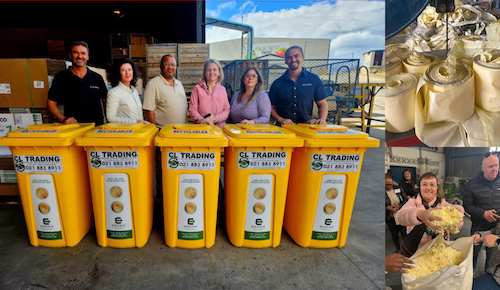
Redfern, who are members of the EPR Waste Association of South Africa (eWASA), repurpose for example their discarded liners to be used for insulation material in ceilings, and are actively encouraging brand owners to bring in bins to collect waste. The waste removal costs alone (by getting other companies to collect waste that they can reuse) are significant.
Compliance, Security and Shared Responsibility
Compliance labelling plays a critical role in protecting consumers, brand owners and the integrity of the supply chain. However, a declaration of compliance on a label is only as reliable as the controls and processes that support it.
South Africa, like many markets, is not immune to the circulation of counterfeit or unauthorised products carrying labels that appear legitimate. Labels and associated product information can potentially be copied, altered or misused, including changes to expiry dates, batch information and other important consumer information. Reported incidents involving food products and over-the-counter medicines demonstrate why the integrity of both the product and its labelling must be protected throughout the supply chain.
This highlights an increasingly important consideration for brand owners, manufacturers and their labelling partners: compliance should extend beyond what is printed on the label to how sensitive artwork, certification marks, variable information and surplus or obsolete labels are controlled.
Robust procedures around access, authorisation, traceability and the secure destruction of obsolete or rejected labels can help reduce opportunities for misuse. Depending on the product and associated risk, additional authentication and security features may also form part of an appropriate brand-protection strategy.
Ultimately, protecting the integrity of a label is a shared responsibility. Brand owners and label manufacturers should work together to understand the risks, establish appropriate controls and ensure that compliance information remains trustworthy from production through to the end consumer. A label may be a relatively small component of a product, but the information and assurances it carries can have significant consequences for consumer confidence, brand reputation and safety.
GS1 Sunrise 2027
The GS1 Indaba 2026 was recently held in Johannesburg. During the event, the Sunrise 2027 global initiative was outlined. Sunrise 2027 marks a pivotal shift for the retail industry: a global transition from 1D UPC barcodes to 2D barcodes, like QR codes, that provide greater transparency, stronger traceability, and richer data across every link in the supply chain.
This initiative supports retailers to ensure their point-of-sale (POS) systems can read and process these next-generation data-packed codes and brands can share more information with their consumers. The GS1 Sunrise 2027 deadline is an industry-wide target date (December 31, 2027) by which global retail point-of-sale (POS) systems are expected to be capable of scanning and processing 2D barcodes.
While still in its implementing phase, adherence to this initiative will give labelling businesses a competitive advantage. However, companies such as Redfern are already on board. The transition ensures more data in one scan, better traceability, improved customer experience, and stronger compliance and product safety.
‘We ensure that we cover everything that requires our attention in the marketplace’, said Raymon Cloete, technical manager at Redfern Labels, ‘In terms of Sunrise 27, we want to bring new symbology in barcoding but more so with fixed streamlines where people have access to better data, particularly with regards to what people purchase. Consumers demand more information about the products they’re purchasing, regulators require the disclosure of more information, and there’s an ongoing need to more effectively track and trace products through the supply chain. We can resolve this with 2D barcodes with GS1 standards inside: a single barcode that has the power to provide all the information consumers need and desire, improve traceability through the supply chain, and scans at checkout.
‘We can assist the customer to prepare for GS1 Sunrise 2027 and the transition to 2D barcodes and GS1 Digital Link technology by registering them with GS1. This can be done by obtaining a unique GLN (global location number) issued by GS1 to their business. This follows the creation of a barcode, linked to a database. We can print the label for your product and can even provide barcode (or QR) printers and scanners. This also includes integration support, consultation and industry guidance.’
Examples of the prominent roles labels play in diverse sectors, all of which Redfern serve and can now accommodate according to today’s demanding global standards, include:
– agriculture (improving traceability from farm to table and ensure product authenticity).
– pharmaceutical (enhancing patient safety, ensuring compliance, and tracking products with precision).
– retail (enabling faster check-outs, better inventory accuracy, and improved customer engagement).
– manufacturing (improving production efficiency, ensuring quality control, and meeting global compliance requirements.
REDFERN
+ 27 11 837 7767
terrya@redfern.co.za
raymonc@redfern.co.za
lancez@redfern.co.za
https://www.redfern.co.za